

Understanding the global education charter through the lens of classrooms, teachers, and school communities
As conversations around education increasingly focus on artificial intelligence, skills disruption, student wellbeing, and lifelong learning, teachers and schools often find themselves at the centre of change—yet rarely at the centre of global dialogue.
The launch of the Public Consultation for Education Charter International (ECI) 2026+ by CCLP Worldwide offers schools and teachers an opportunity to engage with a renewed global framework that directly acknowledges their role in shaping the future of education.
But what does a global education charter actually mean for schools and educators on the ground?
Education Charter International: A Brief Context for Educators
The Education Charter International was originally developed between 1999 and 2003 as a response to growing concerns about inequality, erosion of democratic values, corruption, and the widening gap between education systems and societal needs.
Importantly, the Charter was never intended to serve as a law, regulation, or curriculum mandate. Instead, it articulated shared ethical principles to guide education systems worldwide.
With ECI 2026+, the Charter has been renewed to reflect today’s realities—while preserving its original spirit.
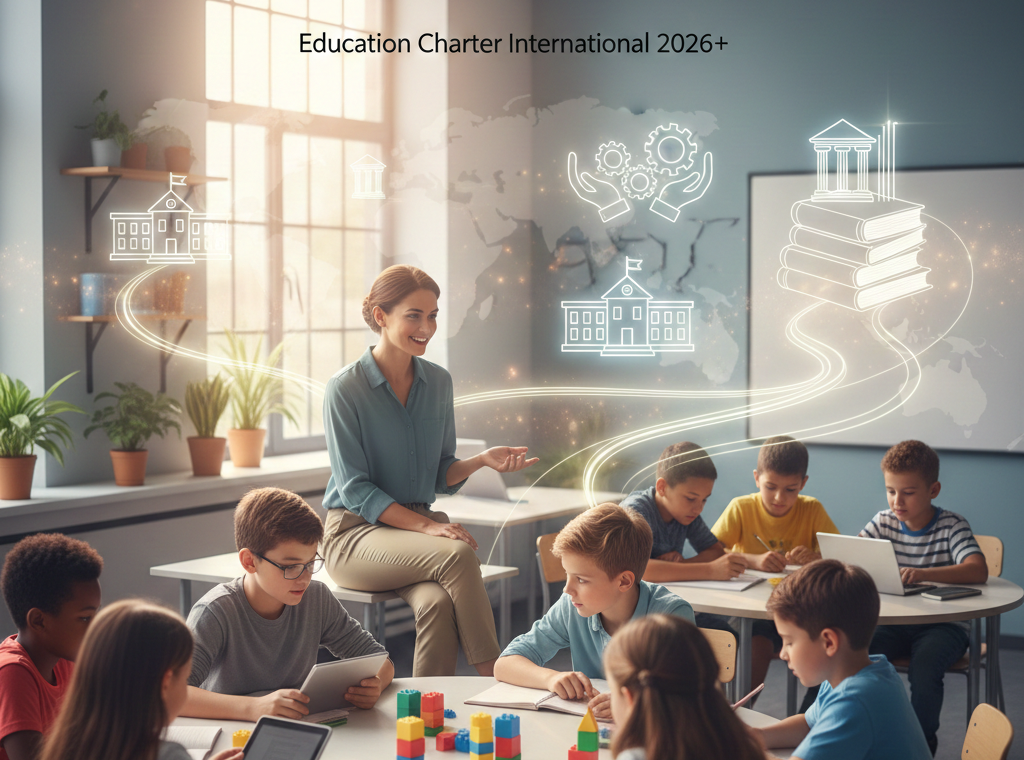
Schools at the Foundation of the Education Continuum
One of the most relevant aspects of ECI 2026+ for educators is its clear recognition of school education (K–12) as the foundation of the lifelong learning continuum.
The renewed Charter highlights schools as spaces where:
- Equity and inclusion must be actively protected
- Citizenship, ethics, and democratic values are first experienced
- Foundational literacy, numeracy, and critical thinking are developed
- Emotional safety and well-being shape long-term learning outcomes
Rather than treating schooling as preparation only for exams or employment, ECI 2026+ emphasises holistic development.
What ECI 2026+ Does Not Ask Schools to Do
For school leaders concerned about additional compliance or reporting burdens, it is important to be clear:
ECI 2026+:
- Does not impose new regulations
- Does not introduce accreditation, certification, or rankings
- Does not require curriculum changes
- Does not override national education policies
Participation is voluntary, non-binding, and non-commercial.
Schools are invited to reflect, not to conform.
Why Teachers Matter in the Charter’s Vision
Teachers are central to the Charter’s philosophy, even though the document avoids prescriptive language.
ECI 2026+ implicitly recognises teachers as:
- Ethical role models in a rapidly changing world
- Facilitators of critical thinking and civic understanding
- Guides in the responsible use of technology and AI
- Key contributors to lifelong learning attitudes
By acknowledging education as a public good, the Charter reinforces the professional dignity and social responsibility of teachers.
Schools, Skills, and the Changing World of Work
The renewed Charter also connects schools more clearly to TVET and skills pathways, recognising that:
- Not all learners follow the same academic trajectory
- Dignity of work begins with respect for diverse talents
- Early exposure to skills and applied learning matters
For schools, this reinforces the importance of:
- Career awareness
- Experiential learning
- Respect for vocational pathways alongside academic ones
How Schools Can Engage with ECI 2026+
Schools and educators may engage with the Charter in simple, non-intrusive ways:
1. Awareness
Reading and discussing the consultation draft within staff groups or leadership teams.
2. Reflection
Considering how existing school values align with principles such as equality, integrity, and accountability.
3. Feedback
Submitting insights through the public consultation—especially from classroom experience.
There is no requirement to formally endorse or adopt the Charter.
Why the Public Consultation Matters for Educators
Too often, global education frameworks are shaped without sufficient input from classroom practitioners.
The ECI 2026+ Public Consultation explicitly invites feedback from:
- Teachers
- School leaders
- Education practitioners
Their lived experience is essential to ensuring that the Charter remains grounded, realistic, and globally relevant.
Aligning with UNESCO Values at the School Level
While ECI 2026+ is an independent initiative, it aligns closely with UNESCO’s emphasis on:
- Education as a public good
- Inclusive and equitable learning
- Lifelong learning for all
- Global citizenship
For platforms such as unescoclub, this alignment reinforces the importance of informed dialogue at the school and teacher level.
Looking Ahead: A Charter Shaped by Practice, Not Theory
The renewal of Education Charter International reflects a simple but powerful idea:
Education systems evolve best when guided by shared values and practical wisdom.
For teachers and schools, ECI 2026+ is not a directive—but an invitation:
- to reflect
- to contribute
- and to help shape a global framework that respects classroom realities
Educators are encouraged to explore the consultation draft and share perspectives that reflect the realities of teaching and learning today.
Education Charter International 2026+, ECI 2026 for schools, Education charter for teachers, Global education framework, Teachers and education policy, Schools and global education, Education as a public good, Lifelong learning framework, UNESCO education values