
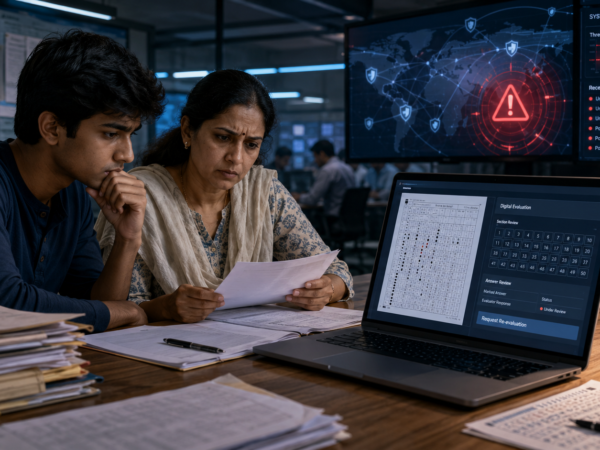
Board examination marks are not just numbers. For students, they influence college admissions, subject choices, scholarships, confidence, and sometimes even the direction of their future. That is why any controversy around board evaluation must be treated not merely as a technical issue, but as a matter of public trust.
The recent controversy around CBSE’ OSM On-Screen Marking system, commonly called OSM, has brought this question to the centre of education debate: can high-stakes examinations move towards digital evaluation without stronger safeguards, transparency and accountability?
What Is On-Screen Marking?
On-Screen Marking is a digital evaluation process in which answer scripts are scanned and then evaluated by examiners on a computer screen instead of on physical paper. In principle, this is not a bad idea. Digital evaluation can improve speed, reduce movement of physical answer sheets, create better records, and make large-scale assessment more manageable.
But technology in education is successful only when it is reliable, secure and trusted. In a board examination system, even a small doubt can create huge anxiety. If students fear that their answer sheets were not scanned properly, pages were missing, PDFs were unclear, marks were not correctly awarded, or the re-evaluation process was difficult to access, the issue becomes much larger than software. It becomes a question of fairness.
Why the CBSE OSM Row Became Serious
The CBSE OSM issue gained attention after students and parents raised concerns about digital checking, scanned answer sheets, post-result services, and re-evaluation processes. Reports described complaints related to blurred scans, missing pages, difficulty in accessing evaluated answer sheets, and uncertainty around whether the uploaded scripts were correct.
This created stress among students who were already under pressure after board results. For many families, re-evaluation is not just a formality. It is the only available path when a student feels that marks do not reflect performance.
The situation became more serious after reports said that CBSE’s post-result services portal faced cyberattack attempts. This portal is important because students use it for verification of marks, obtaining photocopies of evaluated answer sheets, and applying for re-evaluation. CBSE reportedly filed a complaint with the Delhi Police’s cyber unit and stated that attempts were made to destabilise the portal and block legitimate users. At the same time, CBSE said its systems remained secure and no data breach had been detected.
This distinction is important. A cyberattack attempt is serious, but it is not the same as a confirmed data breach. Responsible discussion must maintain that difference.
Leadership Shake-Up and Inquiry
The controversy also saw administrative action. Reports said the CBSE Chairman and Secretary were transferred amid the OSM row, and a one-member committee was set up to examine procurement of OSM services. This raised further questions about how such a high-stakes digital evaluation system was selected, tested and implemented.
Until the inquiry process establishes facts, it would be unfair to jump to conclusions about individual responsibility. But the larger institutional question remains valid: should a national-level examination system adopt large digital reforms without clearly communicating the safeguards to students, schools and parents?
The Real Issue: Digital Reform Without Trust
Digital evaluation itself is not the problem. In fact, a country as large as India will need technology to manage examination scale, speed and records. The problem arises when technology is introduced without enough public confidence.
Students need assurance that:
- their answer sheets were scanned completely;
- every page was readable;
- examiners were properly trained for screen-based evaluation;
- the digital platform was stable;
- re-evaluation was accessible and fair;
- cybersecurity safeguards were strong;
- grievance redressal was transparent.
If these conditions are met, digital evaluation can improve examination systems. If not, it can convert reform into anxiety.
Lessons for Examination Reform
The CBSE OSM controversy should be seen as a learning moment for all examination boards. Digital transformation in education must be built on five pillars.
First, there must be independent technology audits before and after implementation. Second, vendor selection must be transparent and technically rigorous. Third, cybersecurity must be treated as a core requirement, not an afterthought. Fourth, examiners must be properly trained for digital marking. Fifth, students must have a simple, timely and affordable grievance redressal system.
Post-result services must also be designed with empathy. When a student is applying for verification or re-evaluation, the system should not add more stress through portal crashes, unclear instructions, high uncertainty or poor communication.
What Students and Parents Should Do
Students and parents should always use only official CBSE links and notifications for verification, photocopy and re-evaluation services. They should save payment receipts, application numbers, screenshots and official communication. They should avoid unofficial links, social media rumours and sharing personal data on unknown platforms.
Schools should also play a supportive role by guiding students calmly through the official process and helping parents understand deadlines, documents and options.
Final Word
The future of examinations may certainly become more digital. But the purpose of examination reform should not be speed alone. It should be fairness, accuracy and confidence.
Technology can scan answer sheets. Technology can manage portals. Technology can speed up evaluation. But technology cannot automatically create trust.
Trust has to be earned through preparedness, transparency, security, communication and accountability.
The CBSE OSM controversy reminds us of one essential truth: in education, reform is successful only when students believe the system is fair.
CBSE Three Language Policy: Are Students Facing Language Learning or Academic Overload?