
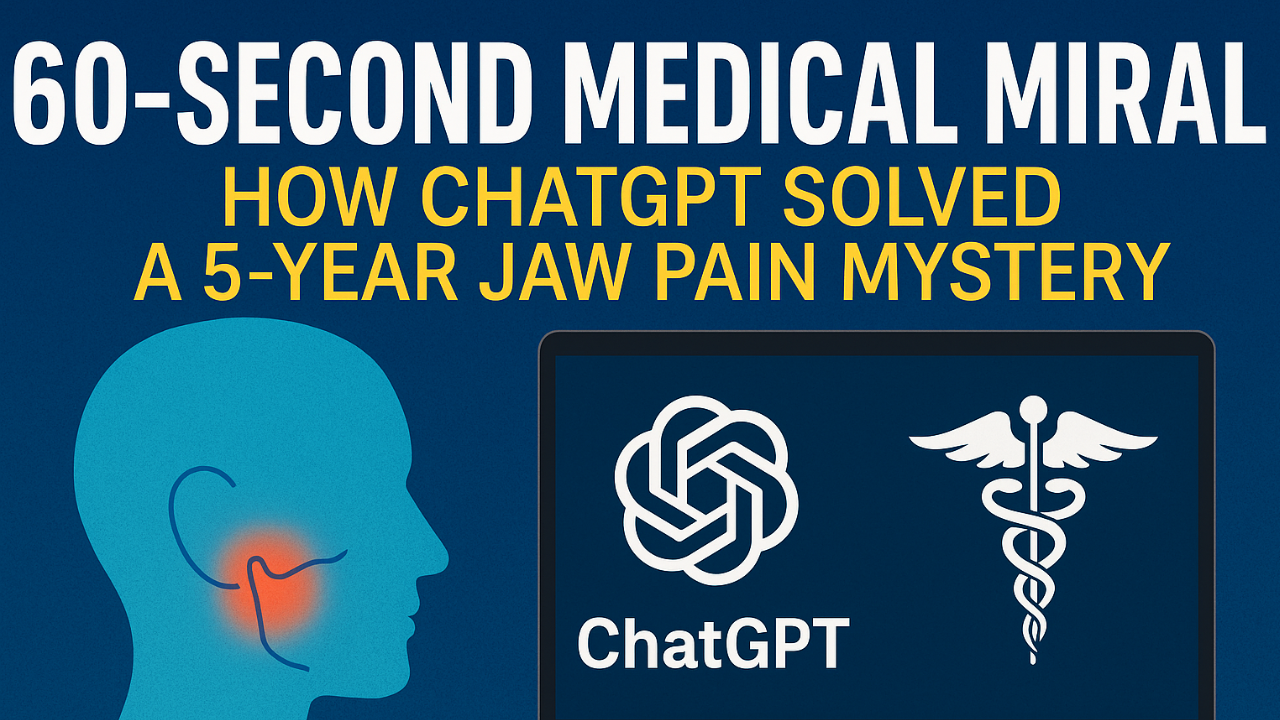
💡 ChatGPT medical diagnosis’s 60-Second Medical Miracle Sparks Global Debate on AI in Personal Healthcare
🩺 From Misdiagnosis to Relief: The Reddit Post That Changed the Narrative
What started as a desperate online post has become a symbol of AI’s emerging role in modern medicine. A Reddit user suffering from chronic jaw clicking and pain—likely a lingering result of an old boxing injury—found no help from traditional medicine: two MRIs, ENT visits, and even surgery recommendations left them with no answers.
In frustration, they asked ChatGPT for help.
“This AI gave me a fix in a minute. Unreal.”
The AI’s suggestion? That the temporomandibular joint (TMJ) disc was likely slightly displaced but still mobile, and advised a simple, non-invasive exercise: open the mouth slowly while keeping the tongue on the roof of the mouth.
Within seconds, the user reported, the clicking stopped. The pain faded. Five years of suffering—gone in a minute.
🧬 Silicon Valley Reacts to ChatGPT medical diagnosis: AI Moves from Theory to Tangible Relief
The revelation exploded on social media after LinkedIn co-founder Reid Hoffman shared it, calling it a “superpower moment” for AI.
“This is what AI is for,” Hoffman posted. “Not just automation, but empowerment.”
The story was soon shared by tech influencers, health experts, and AI enthusiasts as proof that AI is no longer just a backend tool—it’s becoming a life-changing front-line advisor.
👨⚕️ ChatGPT medical diagnosis -Medical Marvel or a Dangerous Shortcut?
While inspiring, the story also raises ethical flags. Health professionals warn that AI should not replace certified medical advice, especially when conditions may involve complex diagnostics or life-threatening symptoms.
Still, a growing number of users are sharing similar experiences, from solving sleep disorders to chronic fatigue—all guided by ChatGPT or other LLM-based tools.
“We can’t ignore these patterns,” says , a digital health researcher at Stanford. “AI is exposing gaps in our medical systems—and sometimes filling them.”
Is Superintelligence the Future? Sam Altman Predicts AI Revolution in ‘Just A Few Thousand Days’
🤖 AI as Your Personal Health Coach
As OpenAI CEO Sam Altman recently noted, Gen Z and Millennial users are turning to AI for everything—from mental health guidance to nutrition and career choices.
“AI is always available, non-judgmental, and capable of synthesizing vast knowledge into personalized insights,” Altman said.
Unlike search engines, AI offers context-aware, empathetic dialogue—making it feel more like a virtual wellness companion than just a chatbot.
ChatGPT medical diagnosis
🚀 ChatGPT medical diagnosis -The Future of AI in Healthcare
While no one is suggesting AI should replace doctors, it’s clear that models like ChatGPT medical diagnosis are evolving into powerful healthcare adjuncts. They offer fast, intelligent guidance, help users ask better questions, and may even spot overlooked connections in symptoms and treatments.
As LLMs become medically trained and regulated, hybrid AI-human care models could soon become the norm.
The Transformative Influence of Artificial Intelligence on Knowledge Production
🔚 Final Thought
Whether a fluke or a future milestone, this 60-second miracle is a reminder that we’re entering an era where AI isn’t just helping us live better—it’s helping us heal smarter.
⚠️ Word of Caution: AI Is Powerful—but Not Infallible
While the ChatGPT Medical diagnosis story has inspired many, experts urge measured optimism. Relying solely on artificial intelligence—especially in matters of health—can be dangerous without the oversight of qualified professionals.
AI tools like ChatGPT are powerful at identifying patterns, offering insights, and generating suggestions. But they lack the ability to perform physical examinations, order lab tests, or understand individual nuances that trained medical professionals detect instinctively.
“AI can support, but it cannot substitute the lived experience, ethical judgment, and contextual reasoning of a human expert,” says , a clinical AI researcher.
In healthcare—and across all domains—human interpretation remains essential. The best outcomes will come from collaboration, where AI augments human capability, but does not replace it.
Patients, developers, and practitioners alike must embrace AI as a complementary tool—not a stand-in for professional expertise.
AI in healthcare, ChatGPT medical diagnosis, temporomandibular joint disorder AI, ChatGPT TMJ cure, AI healthcare revolution, 60-second AI medical miracle, ChatGPT chronic pain relief, AI personal health assistant, ChatGPT success story, medical innovation with AI, ChatGPT medical diagnosis