
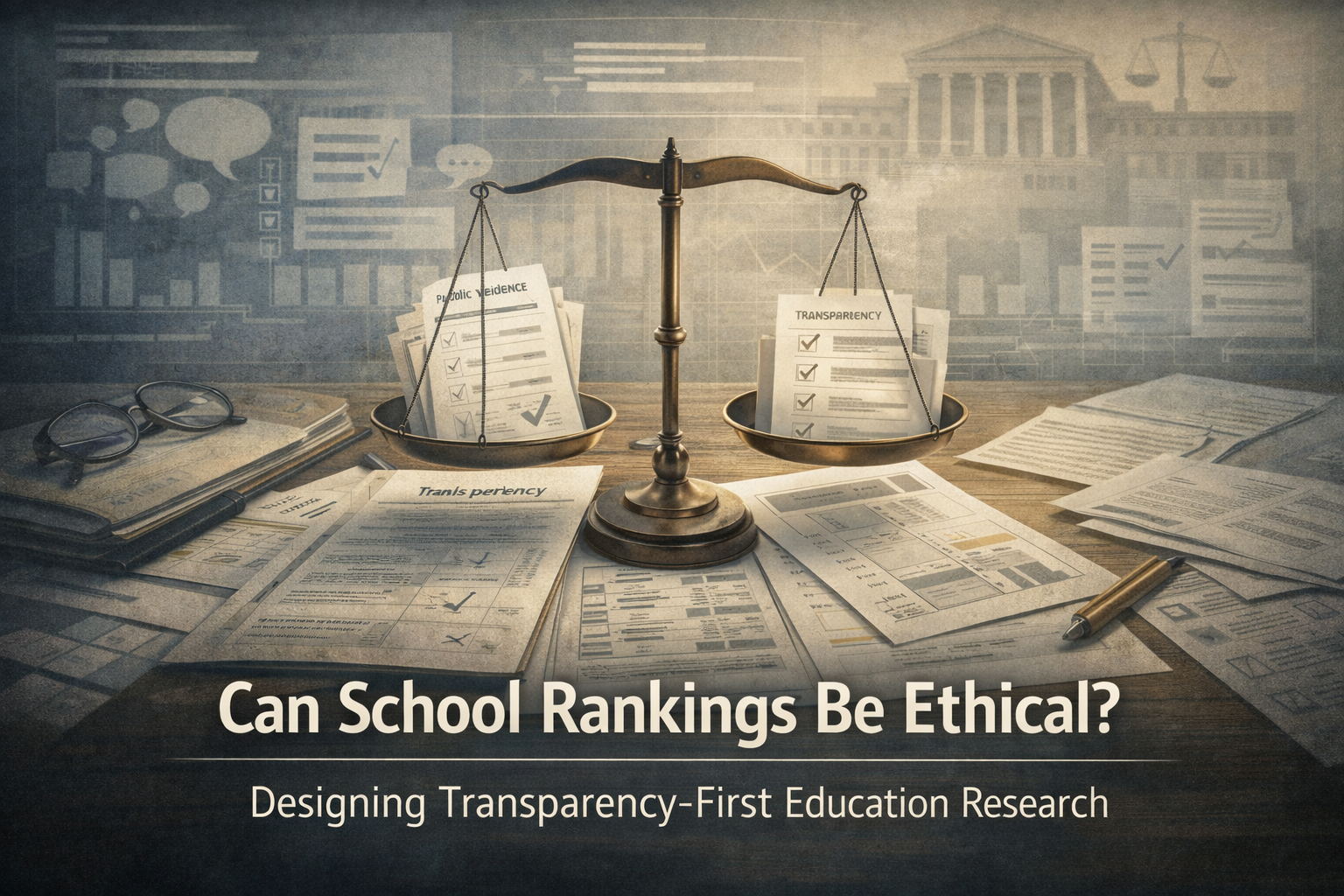
Can School Rankings Be Ethical?
Designing Transparency-First Education Research in India
The Question the Ranking Industry Rarely Asks
After examining why most CBSE rankings fail and what public evidence actually reveals about school quality, a more fundamental question emerges:
Can school rankings be ethical at all?
In a country as large, diverse, and legally complex as India, this is not a philosophical question—it is a practical one. Rankings influence parental decisions, institutional reputations, real estate choices, and student futures. When done irresponsibly, they can mislead, distort incentives, and invite legal risk.
This article explores how school rankings can evolve into ethical, transparency-first education research, aligned with India’s regulatory realities rather than marketing cycles.
Why Ethics Matter More in School Rankings Than in Any Other Sector
Unlike product rankings or consumer reviews, school rankings operate in a uniquely sensitive space:
- Parents make irreversible decisions
- Children bear long-term consequences
- Schools operate under statutory regulation
- Claims intersect with education law and consumer protection
An unethical ranking does not merely misinform—it can actively harm.
This makes education rankings fundamentally different from hotel stars, gadget reviews, or college popularity lists.
The Three Ethical Failures That Plague Most Rankings
Before designing ethical alternatives, it is necessary to name the failures.
1. Opacity Disguised as Expertise
Many rankings use complex language to obscure simple realities:
- undisclosed data sources
- undisclosed financial relationships
- unverifiable scoring logic
When readers cannot trace how a conclusion was reached, expertise becomes an assertion, not a fact.
2. Conflict of Interest Normalised as Industry Practice
Paid nominations, sponsorship packages, award ceremonies, and advertorial placements are often defended as “industry norms.”
Ethically, they are something else:
They create incentives to rank schools higher for reasons unrelated to quality.
Even if bias is unintentional, the structure itself is compromised.
3. Claims Without Legal Accountability
Many rankings implicitly claim:
- superiority
- excellence
- national leadership
without any disclaimer, substantiation, or legal framing.
In India’s evolving legal environment, such claims are increasingly untenable.
What Does “Ethical Ranking” Actually Mean?
Ethical ranking is not about being “nice” to schools. It is about being honest with readers.
An ethical school ranking must satisfy four core conditions:
1. Verifiability
Every parameter must be:
- publicly observable
- independently checkable
- documented
If a reader cannot trace a claim back to a public record, it does not belong in research.
2. Transparency of Limits
Ethical research clearly states:
- What it measures
- What it does not measure
- What conclusions it not draw
Silence about limitations is a form of deception.
3. Independence from Commercial Influence
Ethical rankings:
- Do not charge for inclusion
- Do not sell award titles
- Do not link rank position to advertising
Editorial independence is not a slogan—it is a structural design choice.
4. Legal Defensibility
Every published statement should be able to answer one question:
“On what public evidence is this claim based?”
If that answer is unclear, the ranking is ethically weak and legally vulnerable.
India’s Regulatory Context Makes Ethics Non-Negotiable
India’s school education ecosystem operates within overlapping frameworks:
- State education laws
- Trust/society governance laws
- Consumer protection jurisprudence
- Data transparency expectations
In this context, rankings that rely on perception, promotion, or persuasion are increasingly misaligned with reality.
Ethical ranking design is not idealism—it is regulatory pragmatism.
The Transparency-First Model: A Way Forward
A transparency-first approach redefines what a ranking is meant to do.
It does not:
- crown “winners”
- Predict student success
- replace parental judgment
Instead, it aims to:
- filter verifiable institutional credibility
- Highlight governance maturity
- reduce information asymmetry
The CCLP Good School Rating Framework was designed around this logic.
From Ranking to Research: A Subtle but Crucial Shift
One of the most important ethical shifts is linguistic.
Rankings say:
“These schools are the best.”
Research says:
“Based on these public indicators, these institutions demonstrate documented strengths.”
The difference is not cosmetic. It is ethical, legal, and intellectual.
Why Transparency Builds Trust Better Than Praise
Public trust does not grow from positive language. It grows from predictable honesty.
Schools that rank lower today but understand why are more likely to improve than schools flattered by vague accolades.
Parents who understand how conclusions were reached are more confident—even when choices are difficult.
Transparency does not weaken rankings.
It disciplines them.
The Future of School Rankings in India
Looking ahead, ethical rankings will likely share these characteristics:
- Smaller, slower, more rigorous
- Fewer claims, stronger evidence
- Clear disclaimers and scope limits
- Research-grade documentation
The era of flashy, opaque, and promotional school rankings is approaching its credibility ceiling.
A Final Reflection: Ethics as Design, Not Intention
Good intentions do not make rankings ethical.
Design choices do.
Who pays, who participates, what is measured, what is excluded, and how claims are worded—these decisions determine whether a ranking informs or misleads.
Ethical school rankings are not perfect.
They are accountable.
Where This Leaves the Reader
This research series does not ask readers to abandon rankings altogether. It asks something more reasonable:
Demand evidence. Demand transparency. Demand limits.
When rankings meet those standards, they can serve education.
When they do not, they should be treated with caution.
Editorial Disclosure
This article is part of an independent education research publication by CCLP Worldwide. No schools were surveyed, charged, or invited to participate. All analysis is grounded exclusively in public-domain evidence, regulatory context, and documented institutional records.