
CBSE Mandates Three Languages from Class VI, Enforcing NEP 2020’s Most Ambitious School Reform
The Central Board of Secondary Education introduces the R1–R2–R3 language framework from academic session 2026–27, requiring at least two Indian languages from a list of 44, with full board examination integration set for 2031.
The Central Board of Secondary Education (CBSE) has announced one of the most structurally consequential reforms in Indian school education since the National Policy on Education 1968 — the mandatory introduction of a third language for all students from Class VI, effective the academic session 2026–27. The decision, unveiled during a national webinar chaired by CBSE Chairperson Rahul Singh, gives formal, binding shape to the three-language formula long championed by the National Education Policy (NEP) 2020.
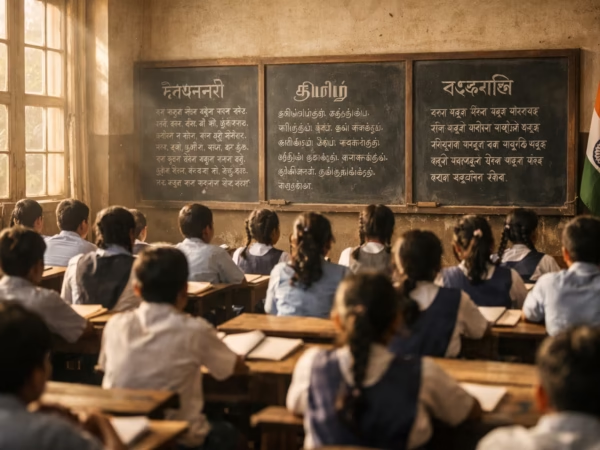
Under the new framework, every student in a CBSE-affiliated school must study three languages — classified as R1 (First Language), R2 (Second Language), and R3 (Third Language) — of which at least two must be languages native to India. The move implements the recommendations of the National Curriculum Framework for School Education 2023 (NCF-SE 2023), which had translated NEP 2020’s language vision into an assessable curriculum structure.
Understanding R1, R2 and R3
The R1 level denotes a student’s primary language, studied with the greatest depth — advanced grammar, literature, and creative writing. R2 is a second language studied at a functional, intermediate level. R3, newly mandated from this academic session, is introduced at Class VI as an introductory-level subject and will be phased through to Class X by 2030–31. The same language may not appear at two R-levels, preventing a student from listing the same language twice to avoid genuinely engaging with a third tongue. Separate question papers and differentiated syllabi will apply to each level.
CBSE has published a list of 44 languages from which students may draw their three choices. This encompasses all 22 languages in the Eighth Schedule of the Constitution of India — including Bodo, Santali, Maithili, Dogri, Konkani, and Sindhi — alongside classical languages, modern foreign languages, and additional regional options. NCERT is developing R-level-specific textbooks for each, with R3 materials expected online in April 2026. The Kaveri series has been introduced for English under the new framework.
From 2031 onwards, exams will be held over three days — one each for R1, R2, and R3. This document represents our collective commitment to a future-ready India.
— News 24 Media Research Study, April 2026The English Question
No aspect of the announcement has generated more debate than the status of English. Since the framework mandates that two of three languages be native to India, English — technically a language foreign to the subcontinent — falls in the foreign-language slot alongside French, German, Spanish, Japanese, and Mandarin. A student choosing English must fill the remaining two slots with Indian languages. This structurally ends the decades-long practice of CBSE schools treating English as the dominant academic medium alongside only one nominal Indian language. Schools and CBSE officials have clarified that English is neither banned nor penalised; it remains a fully valid choice — but one that now requires genuine multilingual learning alongside it.
A Five-Year Phased Rollout
Cognisant of the logistical complexity of overhauling language education across more than 28,000 schools, CBSE has designed a phased implementation roadmap. The current year’s Class VI students will be the first to study R3. The 2027 board examinations will be the last under the existing two-language textbook system. From 2028, board exams will expand to R1 and R2 on two separate examination days. By 2031, when the Class VI cohort of 2026 reaches Class X, board examinations will span three days — one each for R1, R2, and R3 — completing the full transformation.
The three-language announcement is accompanied by several equally significant curriculum reforms for 2026–27: a two-level system in Mathematics and Science for Class IX (a standard paper plus an optional advanced paper whose marks appear separately on the mark sheet), mandatory Computational Thinking and Artificial Intelligence modules for Classes 9 and 10, and compulsory Vocational Education, Art Education, and Physical Education for all students at the secondary stage.
Political Fault Lines and Federal Tensions
The reform has reopened one of India’s deepest political wounds — the language question. Tamil Nadu Chief Minister M.K. Stalin publicly accused the Union Government of deploying education reform as cover for Hindi imposition on non-Hindi speaking states, addressing a large rally in Sankarankovil on the issue. Tamil Nadu has historically maintained a two-language policy — Tamil and English — rooted in the violent anti-Hindi agitations of 1965. The state’s fears are compounded by the Union Government’s withholding of approximately ₹2,152 crore in Samagra Shiksha funds over Tamil Nadu’s refusal to implement NEP 2020 provisions, which the state government has called “institutional blackmail.”
Union Education Minister Dharmendra Pradhan dismissed Tamil Nadu’s concerns as politically motivated, asserting that the policy imposes no specific language and that the choice of Indian language for R3 rests entirely with schools and students. CBSE sources have specifically confirmed that Hindi is not being mandated as one of the two required Indian languages — a Tamil Nadu student could satisfy the requirement through Tamil, English, and Telugu, with no Hindi involved. Nevertheless, the political contestation surrounding the three-language formula reflects a deeper debate about linguistic federalism, cultural identity, and the constitutional boundaries of central authority over a concurrent-list subject.
For EduPedia’s readers — educators, school administrators, students and parents across India — the practical import of this reform is unambiguous: from June 2026, every Class VI student in a CBSE school begins a journey toward genuine, structured trilingualism. Whether that journey produces the multilingual citizens NEP 2020 envisions, or falters against shortages of trained teachers and quality materials, will depend on the unglamorous work of classroom implementation — and the political will to see it through.